What a defects liability period and a workmanship warranty each cover, how long they last, who proves a defect, and where 10-year implied warranties fit.

If you're about to sign a reroof contract, or you've just had a new roof put on, you'll come across a few different terms for what's covered once the job is done: a defects liability period, a workmanship warranty, implied warranties, and a manufacturer's material warranty. They overlap, they run for different lengths of time, and they're about different things. Here's how they fit together. For a summary of what you get from us, see our roofing warranties page.
Short answer: the defects liability period picks up things that don't look right, like a scratch, a dent or a mark, even when the roof is working fine. The workmanship warranty is about performance: is the roof doing its job, or is it leaking because an area wasn't installed correctly? The defects liability period runs for the first 12 months after the work is finished. Our workmanship warranty runs for 10 years, as long as the maintenance is done and the warranty's conditions are met. Neither one replaces your legal rights: the Building Act's implied warranties apply for up to 10 years, whatever the contract says.
| How long | Where it comes from | What it's about | |
|---|---|---|---|
| Defects liability period | The first 12 months after the work is finished | The Building Act 2004, on residential work | Any defect you tell us about in writing in that time, including scratches, dents and marks |
| Workmanship warranty | 10 years, subject to maintenance and the warranty's conditions | Impact Roofing | The installation, flashings and weathertightness |
| Implied warranties | Can be enforced for up to 10 years, and can't be removed by the contract | The Building Act 2004, on residential building work | The work is done properly, with suitable materials, and complies with the Building Code |
| Material warranty | Up to 50 years, depending on the product, exposure zone, roof pitch and colour | The manufacturer (COLORSTEEL® or COLORCOTE®), confirmed at quoting | The roofing material |
The defects liability period is the first 12 months after the work is finished. The 12 months isn't a number we chose. On residential work, this 12-month defect repair period comes from the Building Act 2004. The Act calls it the defect repair period, and contracts often call it the defects liability period, but it's the same thing.
It's where things that don't look right get picked up: a scratch in the paint, a dent in a sheet, a mark on a flashing. The roof might be doing its job perfectly, but if something isn't right, this is the time to tell us.
It isn't limited to how the roof looks, though. Legally, the defect repair period covers any defect you tell us about in writing during those 12 months. MBIE explains how it works on building.govt.nz.
A workmanship warranty is about performance. Is the roof doing its job, or is it leaking because an area wasn't installed correctly?
Our workmanship warranty runs for 10 years, the same length as the implied warranties under the Building Act. It covers our installation, the flashings, and the weathertightness of the roof, as long as the maintenance is carried out and the warranty's conditions are met. If water is getting in because part of the roof wasn't installed correctly, that's what it's there for.
Targeted repairs, where we fix part of an existing roof rather than replace it, have their own terms. Those are set out in the quote.

Separate from anything we offer, the Building Act 2004 gives you implied warranties on all residential building work. MBIE summarises them like this:
These apply whether or not they're written into your contract, and nothing in the contract can remove them. They can be enforced for up to 10 years. To enforce them, though, a dispute usually has to go to court or another formal process, where you show the loss or damage the defective work caused.
Your rights under the Consumer Guarantees Act 1993 and the Building Act 2004 come first, and they stay with the house.
This is where the first 12 months matter most.
MBIE sets this out in its guidance on what happens once building work finishes. It's also why it pays to walk the roof at handover, and to put anything you notice in writing early.
The implied warranties are your legal rights, and they apply automatically. Our workmanship warranty is a promise we choose to give on top of them, and we've matched it to the same 10 years.
What it adds is a simpler route. If a workmanship defect shows up within those 10 years, you tell us in writing and we come back and put it right, within the warranty's terms. You don't have to take us to court or prove your loss first, which is what enforcing the implied warranties usually involves. The main condition is maintenance: the roof needs to have been looked after as set out in the care guide, and the maintenance log is your record of that.
When you're comparing quotes, you'll often see shorter workmanship warranties, such as 5 years. A shorter warranty doesn't shorten your legal rights. The implied warranties still apply for up to 10 years, whatever a warranty or contract says.
| Time after the work is finished | What applies |
|---|---|
| First 12 months | The defect repair period, our workmanship warranty, the implied warranties and the material warranty |
| Years 2 to 10 | Our workmanship warranty, the implied warranties and the material warranty |
| After 10 years | The material warranty, where its term runs that long |
The roofing material itself is covered by the manufacturer, not by us. COLORSTEEL® and COLORCOTE® material warranties can run for up to 50 years, depending on the product, the exposure zone, the roof pitch and the colour. The manufacturer sets the term, and it's confirmed for your roof at quoting. Our roofing materials page explains the products and profiles.
Maintenance is a condition of both our workmanship warranty and the manufacturer's warranties. At handover we give you a maintenance log and a care guide. Keep the log up to date. It's your record that the maintenance has been done, and you'll need it if you ever make a claim or sell the house.

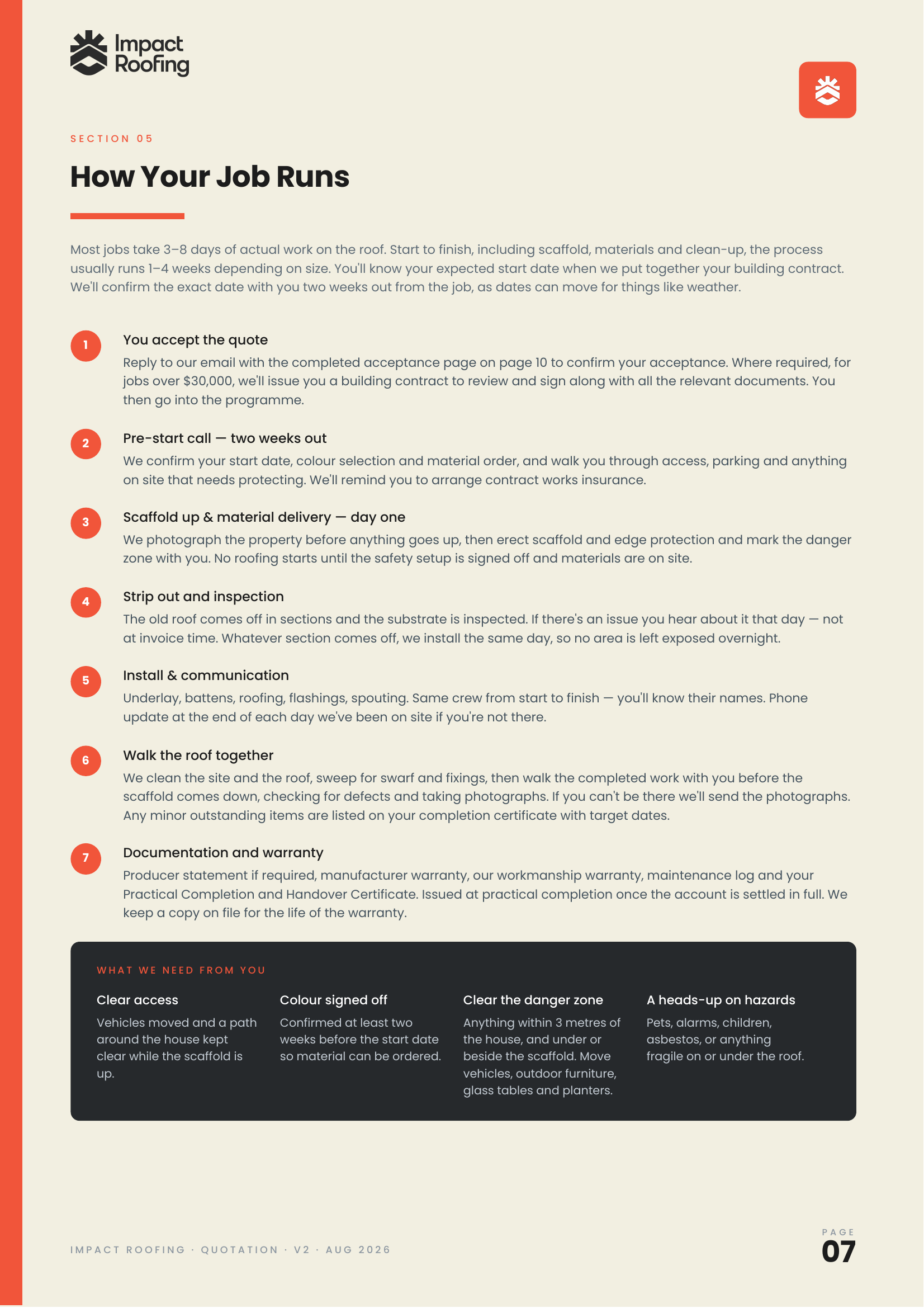
Our workmanship warranty covers our work. It doesn't cover:
All of the warranty paperwork is issued at practical completion, once the account is paid in full.
There's a fuller checklist in what should a roofing quote include?
What is a defects liability period on a new roof?
It's the first 12 months after the work is finished. On residential work, this defect repair period comes from the Building Act 2004. It covers any defect you tell your roofer about in writing in that time, and it's where things like scratches, dents and marks get picked up.
If a roofer offers a 5-year warranty, are they only responsible for 5 years?
No. A workmanship warranty is a promise on top of your legal rights. The Building Act's implied warranties still apply for up to 10 years, and nothing in the contract can remove them. Ours runs for the full 10 years, subject to maintenance and the warranty's conditions.
Who has to prove a defect after the first year?
If the roofer disagrees that something is a defect, you do. In the first 12 months it's the other way round: the roofer has to show that a defect you've reported in writing isn't their fault.
How long is your workmanship warranty?
10 years, as long as the maintenance is done and the warranty's conditions are met. It covers our installation, the flashings and the weathertightness of the roof. Targeted repairs have their own terms, set out in the quote.
Is a scratch or dent on my new roof covered?
If you tell us about it in writing within the first 12 months after the work is finished, it falls within the defects liability period.
How long do roofing material warranties last?
COLORSTEEL® and COLORCOTE® material warranties can run for up to 50 years, depending on the product, the exposure zone, the roof pitch and the colour. The term is set by the manufacturer and confirmed at quoting.
Do I need to maintain my roof to keep the warranty?
Yes. Maintenance is a condition of both our workmanship warranty and the manufacturer's warranties. Keep the maintenance log we give you at handover up to date.
Does the warranty transfer if I sell my house?
Manufacturer warranties may transfer on their own terms. Our workmanship warranty can transfer if the new owner asks us in writing within 30 days of settlement, holds the maintenance log, and the maintenance has been done.
Thinking about a new roof? Request a quote, or call us on 09 376 6331. We're based in Onehunga, Auckland, and you can read more about our residential roofing.
Sources: the defect repair period and implied warranties from MBIE's guidance on implied warranties and defects; who has to prove a defect from MBIE's guidance on what happens once building work finishes; material warranty terms from COLORSTEEL® and COLORCOTE®.
Technically reviewed by Impact Roofing Solutions.
This article is general roofing information based on our experience working on Auckland properties. Every building and roofing system is different, and requirements can vary depending on the existing construction, location, product specification and proposed work. Project-specific requirements should be confirmed before work begins. Building Act and consumer protection information can change, so check the current guidance on building.govt.nz or get advice for your situation.