Rot forms on the top face of the timber, where nobody can see it until the old roof is off. What that means for your reroof quote, and what to ask before you accept.
Short answer: on almost every reroof in New Zealand, some rot or damaged timber is found once the old roof is lifted. What matters is what your roofer does next — whether they stop and tell you, what it costs, and whether you agreed to that in writing before work started.
If you're comparing quotes for a reroof, you've probably noticed something confusing. One is a single fixed number. Another is a similar number, plus a recommendation to hold a contingency on top, plus several pages about what might be found once work starts.
The second looks more expensive and less certain. The difference isn't sales technique. It's what the roofer expects to find.
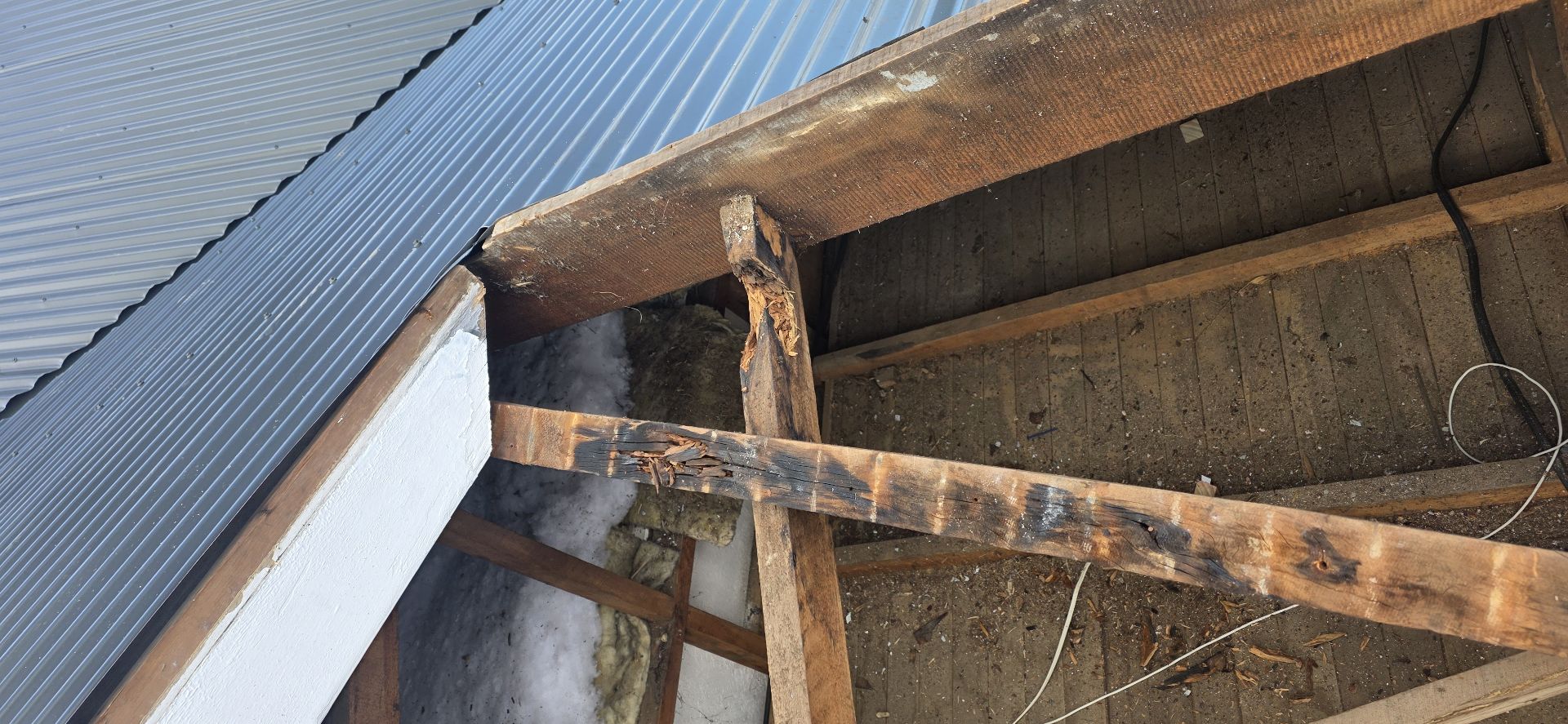
Rot in a roof forms on the top face of the timber — the side the old roof has been sitting on. That's the surface nobody can inspect while the roof is still on.
From inside the roof space you're looking at the underside, so the rotten face is hidden even with good access. And often there's no good access to be had. Some houses have no ceiling hatch at all. Some have a hatch opening into a cavity too shallow to move through. On skillion and sarked roofs there's no roof space to enter — the ceiling is lined directly beneath the framing. Sometimes the only hatch is in a wardrobe full of someone's clothes, or nobody's home when the roofer is there to look.
The timber in question is your purlins — the horizontal battens the roof is fixed to — along with the rafters and barge boards.
None of that is anyone's fault. Getting a contractor and a homeowner in the same place at the same time isn't always practical, and the work has to happen either way. But it's worth knowing beforehand where you can. If you can be there for the quoting visit, and clear access to the ceiling hatch before the roofer arrives, you'll get a more accurate quote and fewer surprises later.
On some older houses the existing roofing iron is also carrying part of the structure itself, and nobody discovers that until it's lifted.
So when a roofer says they can't tell you the condition of your purlins, rafters and barge boards until the old roof is off, that isn't evasion. It's an accurate description of what can be known at quoting stage.
On almost every reroof, something needs doing. Usually it's minor — a few purlins, a barge board, the end of a rafter. Occasionally the structure needs work that goes well beyond roofing, and that isn't predictable in advance.
This is the part worth sitting with: a fixed price that makes no mention of the substrate hasn't eliminated that risk. It has just declined to talk about it. The rot is still there. What changes is what happens when it's found — and whether you were expecting the conversation.
We suggest allowing 15% on top of the quoted price for remedial work.
That figure is a budgeting guide drawn from experience across a large number of jobs. It is not an estimate for your roof, it is not a cap, and it is not a limit on what may be required. Some jobs need nothing like it. A few need more. The work isn't in the quote because until the roof is off there is genuinely nothing to price.
Think about a surgeon operating on a knee. They've done hundreds. They've read the scans, they know the history, and their experience tells them what they're most likely to find and how they'll deal with it. But they can't tell you with certainty until the knee is open. That isn't a failure of skill — it's the honest limit of what anyone can know from the outside. What matters is that they've thought about what they might find, and that you've been told what happens if they do.
A roof is the same. A contingency isn't a hedge against a vague quote. It's the honest shape of a job where part of the scope is invisible at the time of pricing.
The wider question of why quotes differ is covered in why do roofing quotes vary so much?
This is the question to put to every roofer quoting your job, because the answer tells you a great deal.
Here's how we handle it, and the figures are in our written terms rather than left to the day:
Whatever is found, the order is the same: protect the building first, tell you the same day with photographs, then talk about cost.
Some quotes say any rot found will be replaced at no extra cost. That reads as generous, and it's worth thinking through what it does on the day.
If the price is fixed and the roofer finds $5,000 of rotten timber, that money now comes out of their margin. Nothing about their character changes, but their interest and yours have quietly split. The cheapest way through is to replace as little as possible, or to work around it. The expensive way is to do it properly.
You won't be in the roof space to see which one happened. You'll find out in five years, when a leak appears and the roof has to be opened again — new scaffold, new disruption, and an argument about who's responsible for something nobody photographed at the time.
Chargeable remedial work does the opposite. When rot is priced separately, at a rate agreed in advance, the roofer has no reason to leave anything in. Finding it and fixing it is simply part of the job.
So it can cost more at the time. What you're buying is a roofer with no reason to look the other way.
We don't charge for it. It's a written and photographic record of what we could see on visual inspection once the existing roof was removed.
It is not a structural assessment, an engineering opinion or a building survey, and we're not qualified to provide one. Where what we've found may affect the structure of your building, we'd recommend getting advice from a chartered professional engineer or another suitably qualified person before you decide what to do. We'll pass the report and the photographs to whoever you engage, so they're not starting from scratch.
Yes. All building work must comply with the New Zealand Building Code under section 17 of the Building Act 2004, whether or not a building consent is required. Most reroofs in Auckland need no consent, and the obligation applies regardless.
That obligation can't be set aside by agreement. If a compliant roof can't be installed over the retained structure, we won't complete the installation — not because we're being difficult, but because your instruction doesn't make it lawful for us to proceed, and it's our licence at risk.
Often there's a simpler route than a rebuild. The Building Code is performance-based, so compliance can frequently be achieved another way — closer batten spacing, a changed fixing pattern or fixing type, additional underlay or support, or a detail confirmed in writing by the manufacturer or an engineer. That's usually a few hundred to a couple of thousand dollars rather than a major job.
We've written more about what makes a roof compliant, and who actually checks it: most reroofs don't need a building consent, so who checks the work?
The answers will tell you more about the quote than the number at the bottom of it.
Next: what makes a roof compliant, and who actually checks it
Is rot normal when replacing a roof?
Yes. On almost every reroof some remedial work to the timber is needed once the old roof is off. Usually it's minor.
Why isn't rot repair included in the quote?
Because the condition of the timber can't be established until the existing roof is removed. Rot forms on the top face of the purlins, which can't be seen from inside the roof space.
How much should I budget for rot repair on a reroof?
We suggest allowing 15% of the contract price as a guide. It isn't an estimate for your roof and it isn't a cap — some jobs need nothing, a few need more.
Do I need a building consent to replace my roof in Auckland?
Usually not, where you're replacing like-for-like. The Building Code still applies either way.
Who pays if rot is found?
Under our terms, remedial work to the structure isn't included in the quoted price and is charged as it's done, with your approval above agreed thresholds. Check what any quote you're comparing says about this.