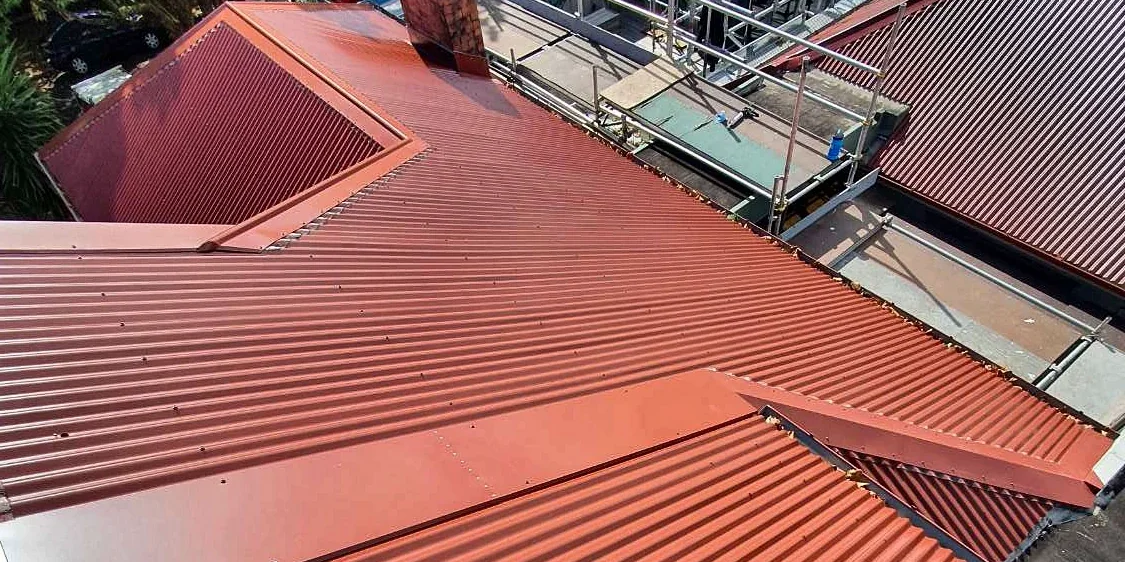
How a roof replacement runs in Auckland, step by step: the quote, lead times, scaffold, strip-off, what's found underneath, the new roof and handover.

Replacing a roof is one of the bigger jobs most homeowners take on, and most only do it once. This post walks through how a reroof runs, from the first site visit to handover, what you'll need to sort out along the way, and how we deal with what we find once the old roof is off.
Short answer: most reroofs take 3 to 8 days of actual work on the roof, and the whole project usually runs 1 to 4 weeks depending on its size. The old roof comes off in sections, the roof is made weathertight at the end of every working day, and you can stay in the house throughout. Most of the care, and a good part of the cost, goes into work you won't see once it's finished: the timber underneath, the fixings, the flashings and the ventilation.
In our experience, most Auckland roofs need replacing somewhere between 30 and 50 years, depending on the material and how well it's been maintained. But sometimes you'll know it's time before then.
We've opened up countless ceilings in Auckland homes and seen the damage that comes from ignoring roof problems. These are the signs we see most often:
Coastal homes, and anywhere exposed to salt air, can deteriorate faster. We see it in East Auckland, in coastal parts of central Auckland such as Freemans Bay and Herne Bay, across the North Shore from Devonport and Takapuna up to the Hibiscus Coast, and on the west coast in places like Piha.
If the roof needs repairs more and more often, replacing it usually makes more sense than continuing to patch it. We've explained where that line sits in what causes roof leaks, and how they're fixed, and a roof inspection will tell you where yours is.
Here's what happens at each step, and what to look out for.
A reliable quote needs someone on site, and into the roof space where that's possible. We call that visit our Whole Roof Assessment. Roof area, pitch, access, what's coming off, the number of penetrations and any power lines near the house all change the price, and none of them can be judged from an address. We've covered that in what does a reroof actually cost in Auckland?
A good quote spells out the roofing profile, the steel and its thickness, the colour, the underlay, the fixings, and your corrosion and wind zones. It should also list clearly what's included and what isn't: scaffold, strip-out and disposal, flashings, spouting, ventilation, power line sleeving, and what happens if rot is found. Where there's a real choice to make, such as whether to replace the spouting or add roof ventilation at the same time, we give two options. There's a full checklist in what should a roofing quote include?
Most like-for-like reroofs, and most tile-to-metal conversions, don't need a building consent. They usually fall under Schedule 1 of the Building Act as exempt work. It isn't automatic, though, and the Building Code still applies in full either way. Changing the shape or structure of the roof, or going from metal to heavy tile, is more likely to need a consent. Where a consent is needed, the roofing is restricted building work, which must be done or supervised by a Licensed Building Practitioner, and you receive a Record of Work at the end. More on that in most reroofs don't need a building consent, so who checks the work?
The structure under the old roof can't be priced until the roof is off, and on almost every reroof some remedial work turns up. We suggest allowing 15% on top of the quoted price. That's a budgeting guide from our experience across a lot of jobs, not an estimate for your roof and not a cap: some jobs need nothing like it, and a few need more. There's more on that below.
About two weeks before the start, we ring to confirm the start date, then confirm it in writing along with your colour and material order. We also talk through access, parking and anything that needs protecting. A few things to sort out on your side:
Before the scaffold goes up, we photograph the property. Those before and after photos protect both of us. If anything turns out to have been damaged by our work, there's a clear record, and we put it right.
The scaffold goes up first and comes down last. Edge protection is enough for work on the roof itself. Where the spouting is being replaced, a full platform scaffold is used so the crew can work along the gutter line. Your quote should say how many weeks of scaffold hire are included. The scaffold is a controlled work platform, so keep children and pets well clear and don't climb it.
Some higher roofs have extra rules. Where someone could fall five metres or more, WorkSafe has to be notified before work starts, and scaffold of that height has to be put up by a scaffolder holding a certificate of competence.
Power lines near the house are the other thing to plan for. Safe working distances are set by law. Within 4 metres of power cables, the cables need protective sleeves. Within half a metre, the lines company has to turn the supply off while the work is done. Sleeving is arranged through the lines company, which for most of Auckland is Vector, and it isn't always obvious at quoting time.

The old roof comes off in sections, and the roof is made weathertight at the end of every working day. Roofing is weather-dependent, so we won't open a roof in unsuitable conditions, and if the weather turns partway through a day, closing the roof up comes first. On some larger commercial jobs, a temporary roof goes over the whole scaffold so work can carry on in any weather.
If the old roof might contain asbestos, it needs testing before work starts. Decramastic-type tiles from the late 1950s to the early 1980s can have it in the coating, and roofs and linings from before 2000 sometimes contain it. If we find or suspect it during the job, we stop work in that area straight away and tell you. Removing more than 10 m² of non-friable asbestos needs a licensed removalist. Our asbestos roof removal page explains how that works.


This is the part nobody can price in advance, and it's the one we most want homeowners to understand. Rot forms on the top face of the timber, the face the old roof has been sitting on, so you can't see it from inside the roof space. Sometimes the old roofing is actually holding part of the structure together, and nobody finds that out until it comes off. Usually the remedial work is minor, such as a few purlins or battens. Occasionally the structure needs work that goes well beyond roofing.
The house comes first: making the roof weathertight comes before any conversation about money. Then this is how we handle what we find, under our Open Roof Rule:
Small items, up to $1,000 plus GST across the whole job, we get on with, photograph and tell you about. Above that we ring you with an estimate and confirm it in writing before proceeding. Above $5,000 plus GST, anything needing a consent, and anything needing a builder, we stop and wait for your written approval. The exact thresholds, and the rates the work is charged at, are in a table in what should a roofing quote include?
There is no charge for the Substrate Report. It's a written and photographic record of what we could see once the old roof was off. It isn't a structural assessment or an engineering opinion. Where what we've found might affect the structure, we'd recommend getting advice from an engineer or another suitably qualified person. Here's more on what happens if rot is found when the roof comes off.
It's also the one time the roof space ventilation can be properly checked. A lot of older Auckland homes were built without proper roof ventilation, or had it blocked when ceiling insulation went in. Adding vents is usually straightforward, and a roof that can't breathe won't last the way it should. We explain why in why your roof needs to breathe.

With the scaffold already up, a reroof is also the easiest time to deal with anything else at roof level. That might be skylights, ceiling insulation, or preparing the roof for solar panels. If you're not home during the work, we check in with you at the end of each day we've been on site.


Before the scaffold comes down, we walk the finished roof with you, check for defects and take photographs. If you can't be there, we send you the photographs. Once the scaffold is down, we come back for a final clean and inspection, and photograph the finished roof with a drone.
At handover you receive the Practical Completion and Handover Certificate, the manufacturer's material warranty, our workmanship warranty in writing (5 years on a reroof, 10 on consented work), the maintenance log and care guide, photographs of any structure that was repaired, and a Record of Work where the job was restricted building work. The full list is in what should a roofing quote include?
You also have legal protection once the job is done: a 12-month defect repair period, and implied warranties under the Building Act for up to 10 years. How those sit alongside our workmanship warranty, and what happens to the warranties if you sell, is in workmanship warranty vs defects liability period.

Two different questions, and the second one is usually the one people mean. In our experience, lead times run roughly like this:
| Type of job | Lead time before work starts | What moves it |
|---|---|---|
| Leak repair | 1 day to 2 weeks | How complex the repair is, whether materials have to be ordered, and dry weather, because sealants won’t bond to a wet roof. |
| Simple, standard reroof | 2 to 4 weeks. Allow up to 6 if the contractor is busy. | Materials take 2 to 4 days to make. Good contractors are often booked out. |
| Larger or more complex reroof | 4 to 8 weeks | Size, the number of junctions and penetrations, and lining up scaffold and other trades. |
| High-spec or architectural work | 8 to 12 weeks or more | Standing seam, shrink-wrapped scaffold, a project manager and several trades to coordinate. |
| Anything needing a building consent | Set by the consent | Work can’t start until the consent is granted, and other contractors’ availability has to line up with it. |
Once we start, most reroofs take 3 to 8 days of work on the roof, and 1 to 4 weeks from scaffold up to scaffold down, depending on the size of the job and the weather.
Every project is different, so treat these as a guide. Request a quote and we'll give you a start date and a timeline for your own roof.
You can stay in the house. There's no need to move out. A few things to expect:
Maintenance is a condition of both the manufacturer's warranty and the roofer's workmanship warranty, and most warranty claims that are declined come down to maintenance rather than workmanship. Auckland is a marine environment. Rain washes most of the salt off a roof, but not from sheltered areas.
And a few things to avoid:
To compare quotes side by side, download our quote comparison sheet.
If you'd like one for your roof, request a quote or call us on 09 376 6331.
How long does a roof last in Auckland?
In our experience, most Auckland roofs need replacing somewhere between 30 and 50 years, depending on the material, how close the house is to the sea, and how well the roof has been maintained.
How long does a roof replacement take?
Most reroofs take 3 to 8 days of actual work on the roof. The whole project, including materials delivery, scaffold, clean-up and handover, usually runs 1 to 4 weeks depending on the size of the job and the weather.
Can I stay in my house while the roof is replaced?
Yes. The old roof comes off in sections and the roof is made weathertight at the end of every working day. Expect noise and some vibration during working hours.
What happens if it rains while the roof is off?
We won't open a roof in unsuitable weather, and if the weather turns partway through a day, closing the roof up comes first. The roof is made weathertight at the end of every working day.
Should I budget extra on top of the quote?
Yes. We suggest allowing 15% on top of the quoted price for remedial work to the structure underneath, which can't be seen or priced until the old roof is off.
Do I need a building consent to replace my roof?
Usually not for a like-for-like reroof, or for most tile-to-metal conversions. Both generally fall under Schedule 1 exempt work, but the Building Code still applies. Changing the roof's shape or structure, or going from metal to tile, is more likely to need one.
How much does a new roof cost in Auckland?
For an average-sized Auckland home, generally $15,000 to $45,000 plus GST for the roof itself. The full breakdown is in what does a reroof actually cost in Auckland?
What should I get at the end of the job?
A handover certificate, the manufacturer's warranty in your name, a written workmanship warranty, a maintenance log and care guide, photos of any repaired structure, and a Record of Work if the job was restricted building work.
Sources: minimum pitches, payment red flags and the handover pack from RANZ's Re-Roofing Guide 2026; contracts, insurance, the defect repair period and implied warranties from MBIE's building.govt.nz; scaffold notification from WorkSafe; power lines from Vector; fixings, underlay and swarf from the NZ Metal Roof and Wall Cladding Code of Practice; washing intervals from NZ Steel's maintenance recommendations.
Technically reviewed by Impact Roofing Solutions.
This article is general roofing information based on our experience working on Auckland properties. Every building and roofing system is different, and requirements can vary depending on the existing construction, location, product specification and proposed work. Project-specific requirements should be confirmed before work begins. Building Code and consent information can change, so check the current requirements with Auckland Council or the relevant project professional where required.
Roofing guides
Seven guides, in the order most people need them.